Most kitchen towels are decoration that occasionally touches a wet dish. You wipe the counter, the water relocates, and the towel comes away oddly dry.
Buying a good one takes about thirty seconds once you know what to look at. Four things decide it, and price is not one of them.
The test that settles it
Splash water on a counter and wipe once. A towel that works lifts the water off. A towel that doesn't shoves it toward the edge and calls the job finished.
Absorbency is the entire product. One reviewer described the good version better than our copywriters ever have: "it's like it just sucks water up with no effort." (Valerie Smith, verified review)
Thin outperforms thick
A thick, plush towel feels expensive in the store and then leaves lint on every wine glass you touch. Flat, tightly woven towels pull water off dishes and wring out fast enough to use again ten minutes later.
Thickness also decides how long a towel stays damp. A heavy one holds moisture all day, which is how a kitchen towel starts to smell by Thursday.
A reviewer put the balance in one line: "It’s super absorbent but still thin." (Stephanie Lanni, verified review)
Size, and why most towels are too small
Our kitchen towels run 18 x 30 in, which is longer than the dish towel most people picture. The extra length matters for the two jobs towels actually do: folding in half over an oven handle, and laying flat as a drying rack for hand-washed pans.
People notice it in the box. "Much larger than expected. Great quality, beautiful print, love the hanging loop!" (Jessica Wilson, verified review)
Look for a hanging loop
A towel on a hook dries between uses. A towel crumpled next to the sink stays wet, and a wet towel stops absorbing, which is the whole reason it exists.
Every kitchen towel we make has a loop sewn in for this reason. It's a small feature that decides whether the towel is dry when you reach for it.
The glassware job
Drying glasses is where cheap towels get exposed. Lint sticks to wet glass and stays visible after the water's gone, so you end up rewashing or buffing with a second towel.
One reviewer uses ours for both ends of the spectrum: "Whether it is general clean up or buffing out my favorite wine or pint glasses these towels are the tool for the job !" (Brian Acker, verified review)
Care: the one habit that ruins a good towel
Fabric softener. It leaves a coating behind that repels water, which is the exact opposite of what you bought the towel for. We tell people to wash warm, skip the softener, and let the dryer do the rest.
Ours are made from 100% recycled materials and go through a normal machine wash. No special cycle, no hand washing, no rules to remember.
How many you actually need
Two per kitchen keeps a rotation going: one on the hook, one in the laundry. Three if you cook most nights or have a dog with opinions about the back door.
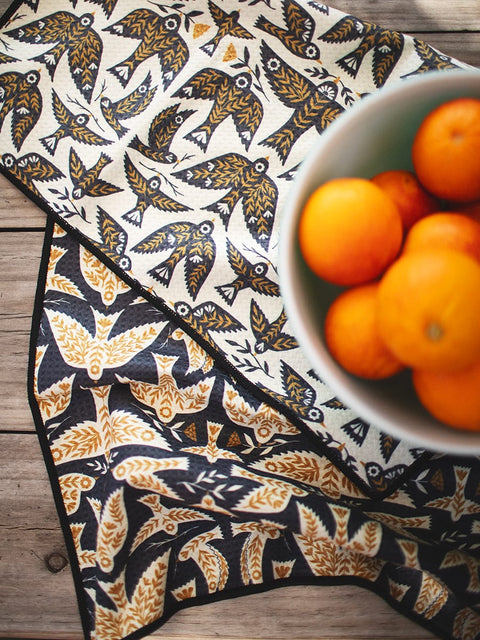
Beyond that, people buy them for the art rather than the drying, which is a perfectly good reason. Ours print on both sides, so the towel looks deliberate whichever way it lands over the handle.
Pick a print that fits your kitchen
Most people know the look they want before they know the towel, so we group ours by theme. Start with coastal kitchen towels for lake houses and beach kitchens, floral and botanical kitchen towels for something quieter, animal kitchen towels when there's a dog or a bird or a bear involved, western kitchen towels for the boots-by-the-door crowd, or states and places kitchen towels when you want the towel to say where you're from.
Kitchen towel or travel towel?
They're different tools. A kitchen towel dries dishes and hands. For drying a person after a swim or a shower, our wander towels are the ones built for it, and they pack down small.
If you're buying for someone else, our kitchen towel gift guide covers which prints land with which people.
One towel, one tree
Every towel we sell plants a tree through our 1-for-1 giveback with Trees For The Future, and it's covered by our Lifetime Warranty and Happiness Guarantee.
Kitchen towel questions we get
What size should a kitchen towel be?
Bigger than the standard dish towel. Ours are 18 x 30 in, which folds over an oven handle without looking skimpy and lays flat as a drying mat for pans.
What's the difference between a tea towel and a dish towel?
In practice, not much anymore. Tea towels were traditionally thinner and used for drying delicate dishes, while dish towels were heavier all-purpose rags. A good modern towel does both jobs, which is why ours are labeled for both.
How do you keep kitchen towels absorbent?
Skip the fabric softener, wash them regularly, and hang them where air can get at them. Softener and permanent dampness are the two things that turn an absorbent towel into a decorative one.