We sell enamel, so treat what follows accordingly. We'd still rather you buy the right camp mug than buy ours and wish you hadn't.
Both materials are good. They're good at different things, and the choice comes down to whether you care more about keeping coffee hot or about how the cup looks doing it.
The short version
Buy insulated stainless if your priority is a drink that stays hot for hours in cold weather, or if your mug lives in a pack that gets thrown around.
Buy enamel if you want to heat a drink over the fire in the cup you drink from, carry less weight, and own something with more character than a canister.
Where stainless wins
Insulation. A double-wall vacuum mug holds temperature in a way no single-wall cup can match. On a freezing morning that difference is the whole ballgame.
Dents beat chips. Drop stainless on rock and you get a dent that nobody notices. Drop enamel hard enough and you can take a chip out of the coating instead.
Lids. Insulated mugs usually come with one, which matters in a truck bed or on a trail where an open cup is a spill waiting for a bump.
If you're headed out in cold weather camping conditions and coffee needs to survive an hour of setup, that's an easy call. Go stainless.
Where enamel wins
Direct heat. An enamel mug goes on a stovetop or straight into a campfire. Boil water in it, heat cocoa in it, then drink out of the same cup you cooked in.
Insulated stainless generally can't do that, because sealed vacuum walls and open flame are a bad combination. Check what the maker says before putting any insulated mug near a fire.
Weight. Two walls and a vacuum add mass. A single-wall enamel mug carries lighter, which registers when it's clipped to a pack instead of sitting in a cupholder.
Looks. This one is subjective and it's also the reason most people choose enamel. A camp shelf of enamelware looks like something. A row of steel canisters looks like a gym bag.
"These mugs are awesome! I bought this one for my wife for our camping trips. We debuted them this weekend. They're really good quality—much thicker walls than other mugs I've seen. Highly recommend!" (Sarah Airozo, verified review)
It ages instead of wearing out. Scratched stainless looks tired. Chipped enamel looks like it's been somewhere, which is why old enamelware ends up in photographs and old thermoses end up in the garage.
What people mean by a tin mug
Camping tin mugs, tin cups, enamel cups, and camp mugs are mostly the same thing described four ways. All of them point at a light metal cup with a coating on it.
True bare tin cups are a museum item at this point. What's sold today under those search terms is nearly always enamel over metal, which is the version you want anyway.
"Nice colors, enamel cups great for camping, or sitting on the deck" (jill pinder, verified review)
The heat question, answered fairly
A single-wall enamel mug holds heat better than a thin ceramic one and worse than an insulated stainless one. Anyone claiming otherwise is selling you something.
What it does instead is let you top up from the fire whenever the cup cools. On a slow morning at camp that's a feature, since walking back to the pot is half the ritual.
In a hurry, in the cold, with no fire going, stainless wins. We're comfortable saying so.
How to pick, by how you camp
- Cold-weather trips, alpine starts, long drives. Insulated stainless, with a lid.
- Fire-centered camping, car camping, cabins, backyard. Enamel, every time.
- Backpacking where the mug doubles as a pot. Enamel, since you can heat in it.
- The mug that lives at home and visits camp twice a year. Enamel, because you'll look at it far more than you'll camp with it.
What ours are
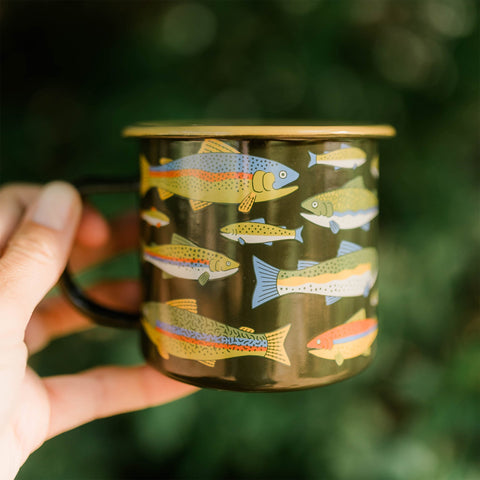
Trek Light mugs are enamel-coated and hand-dipped, 16 ounces each, which works out to 2 cups or one pint. Dishwasher and stovetop safe, and it goes straight into a campfire too.
Every one plants a tree through our 1-for-1 Giveback and carries our Happiness Guarantee. For the deeper dive on the material, read the enamel camping mug guide or what enamelware actually is. Weighing more than two options? We compared all five camping mug materials.
Enamel vs stainless FAQ
Are enamel or stainless steel camping mugs better?
Insulated stainless keeps drinks hot longer and resists dents, which makes it better for cold weather and rough packs. Enamel is lighter, can be heated directly on a stove or campfire, and has the classic camp look. Pick based on whether insulation or fire-safety matters more to your trips.
Can you put an enamel mug on a campfire?
Yes. Trek Light enamel mugs are campfire and stovetop friendly, so you can heat water, coffee, or cocoa directly in the mug.
Do enamel mugs keep coffee hot?
A single-wall enamel mug holds heat better than thin ceramic but not as long as a double-wall insulated stainless mug. The advantage is that you can reheat it over the fire in the same cup.
Do enamel camping mugs chip?
Enamel is a hard coating over metal, so it won't shatter like ceramic, but a hard drop or knock can chip the finish. Chipping takes a hard knock, not everyday use: sipping, washing, the dishwasher, the stovetop, the campfire.