Enamelware is one of those words that turns up in product listings without anyone stopping to explain it. It is worth explaining, because it is the whole reason a camp mug can sit on a fire, go through the dishwasher, and still look good on a shelf twenty years later.
Short version: enamelware is metal with glass fused onto it.
What enamelware actually is
A piece of enamelware starts as a shaped metal body. That body gets coated in a fine glass slurry and fired until the glass melts and bonds to the metal underneath.
What comes out is a hybrid, and every quirk of enamelware traces back to that. The metal gives it the strength and the light weight. The glass gives it the glossy color, the smooth surface, and the fact that it does not hold flavors or stain the way plastic does. Coffee in the morning, wine at the fire, and no ghost of yesterday's cocoa in between.
It also explains the tradeoff people ask about. Glass does not mind heat, so the mug is fine near flames. Glass is hard, so it shrugs off scratches. Glass is brittle, so a real knock against a rock can chip it. Those are three faces of one material, not three separate design decisions.
Enamelware, tin, and stainless are three different things
These get used interchangeably, and they should not be.
Tin mug
When someone says tin mug, they almost always mean an enamel mug. The name is a holdover from an era when a lot of cheap camp gear really was tinned steel. Today the speckled white camp cup people picture is enamelware. Actual bare tin is rare, and you do not want to drink from it hot.
Stainless steel
Bare stainless has no coating at all. Single wall stainless will go on a fire like enamel will. Double wall stainless keeps drinks hot much longer, but it is heavier, it usually cannot go on a flame, and it will never look like anything but a piece of gear.
Enamelware
Enamelware sits between them. Fire friendly like bare metal, easy to look at like ceramic, and much harder to destroy than either. It is the reason the design has barely changed in a century.
We wrote a longer, honest head to head in enamel vs stainless camp mugs, including where stainless is the better buy.
How to tell a good enamel mug from a cheap one
Pick it up. Thin walls are the first thing a factory cuts. You can feel it immediately.
"They're really good quality, much thicker walls than other mugs I've seen." (Sarah Airozo, verified review)
Run a finger around the rim. The lip is where your mouth goes and where cheap enamelware gives itself away. It should be rolled and smooth, not sharp or gritty.
Look at the print in daylight. Color should be even and saturated with no thin patches where the coating pulled away from an edge.
"Great quality! Enameled well and no chips or anything in the print." (Isaac Worrall, verified review)
Check what it is allowed to do. If a mug is genuinely enamelware, the maker should be willing to say dishwasher, stovetop, and campfire out loud. If the listing hedges, there is usually a reason.
Living with enamelware
This is the shortest care section anyone will ever write for you: use it, then put it in the dishwasher.
No seasoning. No hand wash only guilt. No special soap. Enamel is glass, and glass does not care.
The one rule worth remembering is the microwave. There is metal under that glass, so enamelware stays out of it. Heat it on the stove or over the fire instead, which is faster anyway.
If a chip happens eventually, it is cosmetic. Campers have been wearing those as badges for about a hundred years.
What ours are
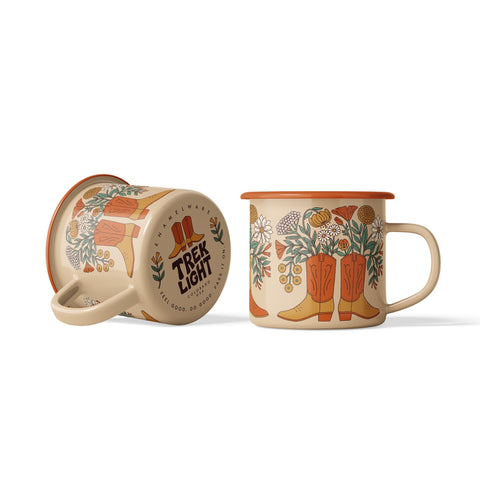
Trek Light mugs are lightweight enamel coated metal with a hand dipped, hand rolled lip, so every one comes out a little different. We think of that as personality rather than a defect.
They hold a full 16 ounces, which is 2 cups or exactly one pint, and they are dishwasher, stovetop, and campfire friendly with hot or cold anything in them.
The designs are the part people actually choose on, so browse the enamel mug collection and pick the one that makes you smile before the first sip.
Every mug plants a tree through our 1 for 1 Giveback, and everything we make is backed by our Happiness Guarantee.
More reading: the full enamel camping mug guide, or camp coffee methods ranked by fuss if the coffee is the project.
Enamelware FAQ
What is enamelware made of?
Enamelware is metal coated in a layer of glass and fired so the two fuse together. The metal underneath carries the strength and the light weight, and the glass on top gives it the hard, glossy, stain resistant surface.
Is enamelware the same as a tin mug?
In everyday use, yes. Most mugs sold as tin mugs today are enamelware. The name stuck from an era when camp cups really were tinned steel.
Can enamelware go in the microwave?
No. There is metal under the enamel coating, so enamelware should never go in a microwave. It is fine on a stovetop or over a campfire.
Is enamelware dishwasher safe?
Trek Light enamel mugs are, with no hand washing required, even after a night over the fire. Enamel is glass, so detergent and heat do not bother it.
Does enamelware chip?
A hard drop or a solid knock can chip the coating, the same as any enamelware. Everyday sipping, washing, stovetops, and campfires will not.