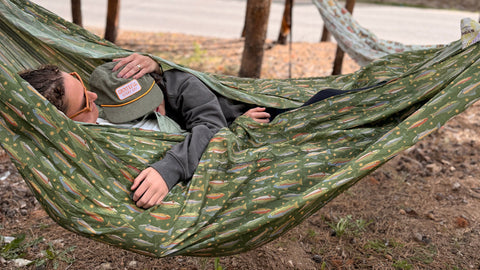
You bought a hammock. Now you want to sleep outside in it, and every guide you find is either a 400 word blog post that says "find two trees" or a 6,000 word ultralight forum thread about whoopie slings and continuous ridgelines.
This is the middle. What a first hammock camping trip actually asks of you, in the order you will hit it.
Before you go: the only two things that ruin a first night
Cold underneath you, and a bad hang. That is it. Bugs and rain are solvable and predictable. Those two are the ones that send people back to a tent.
Cold underneath you. In a hammock your sleeping bag compresses flat under your body, and compressed insulation does nothing. This surprises everyone. A bag rated to 20 degrees will feel like no bag at all if there is nothing between you and the air. Below about 70 degrees you want something under you: a sleeping pad works, an underquilt works better. We wrote the whole thing up in our winter hammock camping guide, and it is worth twenty minutes before your first cold night.
A bad hang. Hung tight and flat, a hammock folds you into a banana and squeezes your shoulders. Hung with a deep sag and slept in diagonally, it is flat. This is not a preference, it is geometry, and it is the single highest leverage thing you will learn. Read how to set up a hammock at the right angle before you leave the house, and practice once in the yard.
Where you are actually allowed to hang
The rules are less restrictive than people assume and more restrictive than people hope.
- National forests and most dispersed camping: generally fine, with tree-friendly straps.
- National and state parks: varies by park, sometimes by campground within a park. Some ban hanging from any tree, some allow it with wide webbing only. Call the ranger station. It takes four minutes and it is the difference between a trip and a citation.
- Established campgrounds: usually yes, often with a rule about strap width.
- Wherever you land: use straps at least one inch wide. Rope and thin cord cut into bark and that is what gets hammocks banned from places.
Trees want to be about 12 to 15 feet apart and thick enough that you cannot wrap your hands around them. Living trees only, never a dead one, and look up before you commit. Standing dead branches are the actual danger in a forest, and they do not care what you are sleeping in.
What to bring on the first trip
Ruthlessly short list. Add to it after you learn what you personally miss.
- The hammock and its hammock straps. Non negotiable, and check they are in the bag before you leave.
- Something insulating underneath. Sleeping pad for the first trip, underquilt when you are hooked.
- A sleeping bag or quilt for on top.
- A tarp if there is any chance of rain. Any chance.
- A bug net if it is summer and you are anywhere with standing water.
- A small stuff sack or dry bag for the things you want to reach at 2am. Gravity is not your friend in a hammock and anything set on the ground is now four feet away and invisible.
Notice what is not on that list: a hammock tent, a ridgeline organizer, a bottom entry double layer anything. You do not need a system yet. You need a night outside.
Setting up camp, in order
- Pick your trees before you unpack anything. Walk the site. Look for two solid trunks, right spacing, nothing dead overhead, and a slight slope so water runs away rather than under you.
- Straps on first. Get the straps ready to clip in and hang the hammock next.
- Aim for about 30 degrees of sag in the suspension. It will look wrong. It is not wrong.
- Tarp before dark, always. Even under a clear sky, unless you're really willing to roll the dice. Setting a tarp in the rain in the dark is a memory you'd probably like to avoid.
- Insulation in, then bag, then you. Sit in the middle, swing your legs up, lie back, then shift diagonally until your body goes flat.
Sit height is worth a second of thought. Aim to sit in it like a chair with your feet on the ground. That is roughly right for getting in and out at night without a production.
Your first night, honestly
You will wake up at some point convinced you are cold, and it will be your back or your shoulders, not the air. That is compressed insulation. Reach down, shift your pad, go back to sleep.
You will also probably sleep better than you expected. That is not brand copy, it is the most common thing customers tell us after twenty years: the first hammock night is either the best sleep they have had outside or a lesson in what they got wrong about the hang. Rarely anything in between.
If you want the physiology behind why, we went into it in our guide to sleeping in a hammock.
Rain, bugs, and no trees
Rain. A tarp pitched with the edges low sheds weather better than a tarp pitched high and pretty. Add drip lines, a short length of cord tied around each suspension line under the tarp, so water runs off instead of tracking down the strap and into your hammock.
Bugs. A net that covers the whole hammock beats a net that covers your head. Mosquitoes bite through fabric pressed against skin, which is most of your underside.
No trees. It happens, and it is not the end of the trip. There are more anchors out there than people notice. We wrote about hanging a hammock with no trees, and if the answer turns out to be indoors this weekend, how to hang a hammock indoors covers that too.
Leave the site better
Wide straps, living trees, no cutting, no nails, and pack the whole thing out. Hammock camping has a very small footprint compared to a tent pad, and that is one of the honest arguments for it. Keeping it that way is how hammocks stay allowed.
Every hammock we sell plants two trees, which is our small version of the same idea.
Hammock camping questions we get
How do you comfortably camp in a hammock?
Deep sag, diagonal lay, insulation underneath. Those three in that order solve almost every comfort complaint. A flat, tight hang is the cause of most of the rest.
Is hammock camping better than a tent?
For a lot of people, yes, and for some, no. Hammocks win on sleep quality, setup speed, wet or rocky or sloped ground, and pack size. Tents win on very cold nights without the right insulation, on treeless terrain, and when you have gear you want to keep inside with you. We made the longer argument in tent vs hammock camping.
What temperature is too cold for hammock camping?
There is no fixed number, because it depends entirely on what is under you. With a proper underquilt people hammock camp well below freezing. With nothing underneath, 60 degrees will keep you awake.
Can two people camp in one hammock?
Two people fit in a double and it is great for an evening. For sleeping, most couples end up in two hammocks, because you both roll to the middle. Ours is rated to 440 pounds, so capacity is not the limit. Sleep is.
Do I need special straps?
You need webbing at least one inch wide, so it spreads the load and does not cut bark. Rope does not qualify. Our tree friendly hammock straps are 9.8 feet each with one inch webbing, which covers most trees you will find.
Go do it
The first hammock camping trip has a very short list of ways to go wrong, and you have now read all of them. Hang high, sag deep, sleep diagonal, put something under you.
If you still need the hammock, ours comes with the straps in the box. Shop double hammocks with straps.