Hammock straps are the least interesting thing in your pack and the one most likely to ruin a night if you get it wrong. They are also the part people buy last, usually after discovering that the hammock they just bought does not come with any.
Here is what actually separates one set from another, and how to not overthink it.
Why straps instead of rope
Two reasons, and only one of them is about you.
The tree. Rope and thin cord concentrate hundreds of pounds onto a narrow line and cut through bark. Bark damage is not cosmetic, it is how a tree loses the layer that moves water and food up the trunk. This is exactly why parks and campgrounds started banning hammocks, and it is why most places that still allow them specify a minimum strap width.
The knot. Rope needs a knot that holds under load and still unties in the morning after a night of rain. Straps skip the problem entirely: wrap, thread, hook, done. If you want to learn the knots anyway, we have a whole guide on how to hang a hammock with rope. Most people try it once and then buy straps.
The four things that actually differ
Width
One inch is the number to look for, and it is the number most land managers specify. Wider webbing spreads the load across more bark. Anything narrower than an inch is doing the same thing rope does, just flatter.
Length
This is the spec people get wrong. Short straps look tidy on a product page and then strand you at a campsite where the only two usable trees are 18 feet apart or three feet thick.
Around 9 to 10 feet per strap is the practical sweet spot. It handles a fat trunk, a wide gap, and the case where you need to wrap twice. Ours are 9.8 feet each, two in the set.
Stretch
Nylon comes in two behaviors. Static nylon holds its length under load. Dynamic nylon, the kind used in climbing rope, is built to stretch and absorb a fall.
For a hammock you want static. Stretchy suspension means you hang it at a good height, get in, and slowly descend to the ground over the next hour. Every strap set worth buying says static or non-stretch somewhere on the page. If it does not say, assume it does.
Attachment points
Most straps are a loop of webbing with a row of sewn loops along it, so you pick the loop that gives you the height and sag you want. That adjustability is the whole feature. Systems with a single fixed loop force you to move the strap up and down the trunk instead, which is slower and harder in the dark.
What you do not need to care about
- Weight rating, mostly. Strap sets are rated to 400 to 500 pounds. Two adults do not approach that. Buy on width and length instead.
- Carabiners versus hooks. Both work. Hooks are faster, carabiners are marginally more secure. This is not a decision worth research.
- Ultralight strap sets. Cutting three ounces off your suspension is a real thing for people counting grams, and it is the wrong place for a first buyer to spend money or fuss.
- Brand matching. Straps are universal. Any strap set hangs any hammock, including a hammock from a different brand.
How long a strap do you actually need
Rough guide, per strap:
- Backyard, two known trees, same spot every time: 6 feet is plenty.
- Campgrounds and travel, trees you have never seen: 9 to 10 feet. This is the answer for almost everyone.
- Big old trunks, or hanging between a tree and a post: 10 feet plus, or carry an extra set.
The failure mode is always the same and always the same direction. Nobody has ever stood in a forest wishing their straps were shorter.
Hanging with them, quickly
- Wrap the strap around the trunk at head height or a bit above, higher than feels right.
- Thread the tail through the loop at the other end and pull it snug against the bark.
- Clip your hammock into whichever sewn loop gives you a deep curve, roughly 30 degrees of sag.
- Sit in it. If you can sit like it is a chair with your feet flat on the ground, you are close.
The sag is the part everyone gets wrong on the first try. A tight, flat hang is what makes people say they cannot sleep in a hammock. If that is you, read how to set up a hammock at the right angle before you buy anything else.
What we make
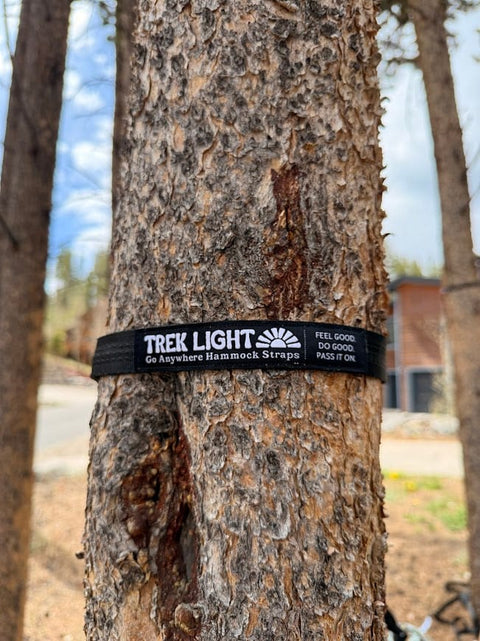
Our tree friendly hammock straps are two straps, 9.8 feet each, one inch webbing, about six ounces a strap, rated to 440 pounds, in 100% nylon static webbing so they do not creep down over the night. They fit any hammock, ours or anyone else's, and they pack down small enough to live permanently in a car door pocket.
They are also already in the box with every double hammock with straps we sell, which is a small thing that we think should be standard and mostly is not. One tree planted for every set, same as everything else we make.
Hammock strap questions we get
Do hammock straps damage trees?
Wide webbing does not. One inch or wider spreads the load across enough bark that a healthy tree is unaffected by a night or a season. Rope, cord and wire do cause damage, which is what the rules in most parks are actually written about.
How long should hammock straps be?
About 9 to 10 feet each for general use. Shorter is fine for a fixed backyard setup where you already know the trees. Longer never hurts except in ounces.
Will any straps work with my hammock?
Yes. Hammock suspension is effectively universal, so a strap set from one brand hangs a hammock from another. Check that your hammock has carabiners or loops at the ends, and if it does not, you will want a set that includes them.
Can I use ratchet straps or tie-down straps?
Please do not. Ratchet straps are metal, heavy, and capable of crushing bark under mechanical advantage, and the hardware sits right where your shoulder goes. They are not designed for a load that swings.
Are hammock straps sold separately?
Usually, yes, and that is worth checking before you compare prices between brands. A hammock that looks cheaper often is not once suspension is added. We include them, and we also sell the set on its own for a hammock you already own.
The short version
One inch wide, about ten feet long, static nylon, multiple attachment loops. That is the whole specification. Everything else on a strap product page is detail.
Get the straps right and the hammock part takes care of itself. Shop hammock straps, or start with a double camping hammock that already has them in the box.