Search "best camping hammocks" and you get twenty lists recommending the same four hammocks in the same order, usually because of the same affiliate program. Most of them have never hung any of them.
We have been making hammocks since 2003. Same family, same obsession, twenty-plus years of small changes to the cut, the fabric and the stitching because customers kept telling us what a hammock should feel like. Here is what we have learned about what actually matters, and where the popular hammocks land.
What makes a hammock feel good
Almost nobody buys a hammock for a number on a spec sheet. They buy it for a feeling, and the feeling comes down to four things.
How flat you can lie. This is the whole game. A hammock that is wide enough, hung with a deep sag, lets you lie across it on the diagonal and settle in almost flat, with none of the pressure points that wake you up on a mattress. Too narrow, or strung tight, and you get the banana shape everybody complains about.
How the fabric feels against you. Parachute nylon should be soft on bare skin, not slick or crunchy, and it should breathe. Ours is the piece we have spent the most time on over the years, because it is the part you actually touch.
How well it disappears. A hammock you have to think about carrying is a hammock that stays home. Ours is 18 ounces and packs to about 5 by 8 inches, small enough that it lives in a car door pocket or the bottom of a daypack and you forget it is there until you want it.
Whether it is still yours in ten years. This is where ripstop comes in, and ripstop does exactly what the name says. Add triple-stitched seams and it is the reason people still write to us about hammocks they bought in 2009. We back all of it with a lifetime warranty, including hammocks we sold before that warranty existed.
How the popular doubles compare
| Double hammock | Ripstop | Straps included | Fabric | Weight |
|---|---|---|---|---|
| Trek Light Double Hammock | Yes | Yes | 70D ripstop parachute nylon | 18 oz |
| ENO DoubleNest | No | No | FreeWave 70D nylon | 19 oz |
| Kammok Roo Double | Yes | No | GravitasX 40D ripstop nylon | 17.1 oz |
| Wise Owl DoubleOwl | No | Yes | 210T parachute nylon | 26 oz |
Read the first two columns and the decision more or less makes itself.
Ripstop. Most of the hammocks on the market are not. Given the choice between a hammock built to stop a tear and one that is not, for roughly the same money, there is not much to think about.
Straps. A hammock without them is a bag of fabric you cannot hang. Two of the four arrive that way, so the one that looks cheaper on the shelf often is not once you add the roughly $25 for suspension.
Only one of the four is ripstop and arrives ready to hang. Ours also uses the more durable of the two ripstop fabrics here, which is a choice we made a long time ago and have never walked back. A lighter hammock that does not last is not lighter, it is temporary.
The other three, honestly
ENO DoubleNest. The one you have seen in every outdoor shop in America. It is a good hammock and a safe choice. Not ripstop, and you will be buying straps separately.
Kammok Roo Double. Ripstop, thinner material, and straps sold separately.
Wise Owl DoubleOwl. The value pick, and it does come with straps. Not ripstop, and the heaviest by a good margin, which matters on your back and not at all in a car.
And ours
Twenty-plus years of making one thing well, from sunny Colorado, still family run.
What you get: ripstop fabric soft enough that people nap in it on purpose, wide enough to lie flat and sleep a full night, light enough to forget you packed it, and a No-Flip design so getting in is a sit rather than an event. It is covered for life. Every one plants two trees, the only product we make that plants two.
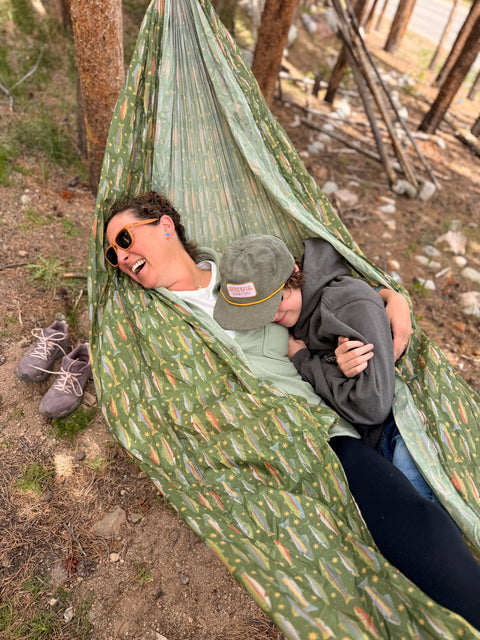
And it comes in prints. That sounds like a small thing next to a spec sheet, and it is the reason most people pick theirs. The camping hammock aisle is grey and forest green. Yours does not have to be.
The part that matters more than which one you buy
The hammock does not make the night comfortable. The hang does.
Any hammock strung tight and flat will wreck your back. Any hammock hung with a deep sag and slept in on the diagonal is genuinely better than a bed for a lot of people. We have watched this in customer email for twenty years, and almost every "I cannot sleep in a hammock" story turns out to be a setup story.
Before you spend anything, read how to set up a hammock at the right angle. If it changes your mind about hammocks entirely, that beats a return.
Which one should you buy
- Your first hammock: a double, ripstop, with the straps included. Wider is easier to get comfortable in, and you will not have a second thing to order.
- Backpacking: compare hammock plus straps, not hammock alone. The lightest hammock stops being lightest once you add suspension.
- Car camping, festivals, the backyard: weight stops mattering. Buy the one you want to look at and hang in.
- A gift: buy something with a print. A grey rectangle is a fine hammock and a forgettable gift.
- Kids: a different question worth reading first. We cover the best hammock for kids and how to hang one safely.
Camping hammock questions we get
Is ripstop nylon better for a hammock?
Yes, and the name tells you why. Ripstop is woven so a small tear stops instead of running, which matters a lot for something holding your full weight against tree bark and buckles. Ours is 70D ripstop parachute nylon. Of the best-known doubles, only ours and Kammok's are ripstop at all.
What is the best camping hammock for beginners?
A double, ripstop, with straps included. Doubles are wider, which makes it easy to find the diagonal lay that gets you flat, and that lay is what people mean when they say a hammock is comfortable. Skip the ultralight singles until you know you love sleeping in one.
Do camping hammocks come with straps?
Some do and some do not, and it is the most expensive detail to miss. Ours include Pro Hanging Straps and carabiners. Two of the three best-known alternatives sell suspension separately, which adds about $25.
Is a double hammock worth it for one person?
Yes, and most solo hammock campers use one. The extra width is what lets you lie diagonally and get flat. Two people fit. One person gets comfortable.
Do I need a hammock tent?
No. What people mean by hammock tent is a hammock plus a bug net plus a tarp, bought separately as you need them. Start with the hammock and straps.
What else do I need for my first hammock camping trip?
Less than you think, and it changes with the temperature. Start with our winter hammock camping guide if the nights are cold, because insulation underneath you is the piece beginners always miss.
The short version
These hammocks are closer on paper than any list will admit. What separates them is how the fabric feels, how flat you can lie in it, whether it is ripstop, and whether it arrives ready to hang.
Ours is all four, and has been for twenty-plus years. Shop double hammocks with straps, or read the portable hammock guide if pack size is what you care about.
For trip ideas, see our guide to camping and hiking with a hammock. Heading out with a rod or hunting gear? Read about hammocks for hunting and fishing trips.