Every hammock claims to be portable. Then you get it home, unpack it, and discover "portable" meant a canvas slab with a wooden spreader bar that lives in the garage forever.
We have been making packable hammocks since 2003, so we have opinions about this. Here is what portable actually means, what the words on the label are trying to tell you, and how to figure out whether a hammock will genuinely come with you or quietly become furniture.
Portable, packable, collapsible, foldable: what the words mean
These four words get used interchangeably in product listings, and they should not be. They describe different things.
- Packable is the honest one. It means the hammock compresses into a stuff sack and stays there without a fight. This is the word to look for.
- Portable just means someone decided it could be moved. A 40 pound hammock with a stand is technically portable. So is a piano.
- Collapsible and foldable almost always refer to the stand, not the hammock. If a listing says "foldable hammock" and shows a metal frame, you are shopping for a stand with a hammock attached, and it is going in your trunk, not your backpack.
None of this is a scam. It is just imprecise. But if you want the kind of hammock that ends up on a plane, in a daypack, or stuffed in a beach bag, "packable" is the word that survives contact with reality.
The four numbers that actually decide it
Packed size. This is the one that matters most and the one listings bury. A hammock that packs to the size of a water bottle goes anywhere. A hammock that packs to the size of a sleeping bag goes in the car and no further. Ours packs down to about a water bottle, which is why people keep them in a glovebox for years and forget they are there until they need one.
Weight. Under two pounds for the hammock is the line between "I'll bring it" and "I'll bring it next time." Straps add weight, and most people forget to count them. Our Go Anywhere Pro straps are 6 oz each, so budget for the pair.
Setup time. If hanging it takes longer than five minutes, you will stop doing it. Knots are the usual culprit. Strap systems with sewn loops let you skip knots entirely, which is the whole reason they exist.
What is included. This is where the price comparison falls apart. Plenty of cheap hammocks arrive with no suspension at all, and then straps cost another $25 to $40. Read the box.
Ultralight is a real category, and most people do not need it
Ultralight hammock camping is its own sport, with people counting grams on their suspension hardware and sleeping under a tarp in November. If that is you, you already know what you want.
For everyone else, the honest answer is that the difference between a genuinely light hammock and an ultralight one is a few ounces you will never notice, and the ultralight version usually gives up width, durability, or both to get there. We would rather you have a hammock big enough for two people that lasts twenty years than one that saves four ounces and feels like sleeping in an envelope.
What travel actually asks of a hammock
A packable hammock is the rare piece of gear that earns its space in a bag over and over:
- Airports. A long layover plus two trees, or two structural columns, or a quiet corner of a park near the terminal. We have written a whole love letter to this one.
- The beach. Sand does not stick to ripstop nylon the way it sticks to towels and blankets. Shake it out and go.
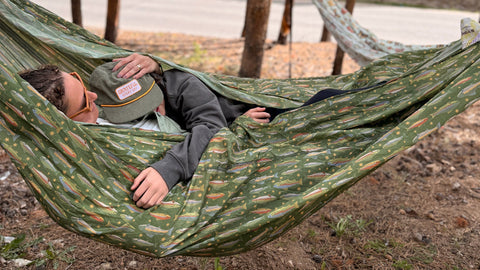
- Campsites. Off the ground, off the roots, off the rocks. Plenty of people sleep in one full time.
- Backyards and festivals. Honestly the most common use, and there is nothing wrong with that.
- Hotel rooms and dorms. Yes, people do this. Carefully.
What if there are no trees?
This is the question behind most searches for hammock stands, and it deserves a straight answer: we do not sell one.
What we would tell you is that a stand solves a narrower problem than people expect. It is heavy, it lives in one place, and it costs more than the hammock. If your hammock is going to hang in the same backyard spot every day, a stand is genuinely the right answer and you should buy a good one from someone who makes them.
If your hammock is going to travel, a stand defeats the point. Two trees, two porch posts, two sturdy fence posts, a pair of columns, or one tree and one solid anchor will all work, and a good strap set makes any of them a thirty second job. We have a whole guide on how to hang a hammock, including how far apart the anchors need to be and the sag angle that makes the difference between comfortable and awful.
What we make, plainly
Our Double Hammock and Pro Strap bundle is currently $78 and comes with everything except the trees. Ripstop nylon, big enough for two and perfect for one, a never-flip design so you can get in without the comedy routine, and tree-friendly straps that need no knots. It packs to about the size of a water bottle. Every sale plants a tree, and we have been doing that long enough that the total is past 150,000.
We are not going to tell you it is the lightest hammock ever made, because it is not, and the brands chasing that number are welcome to it. Ours is the one that has been coming out of glove boxes and carry-ons since 2003 and still gets handed down.
The short version
Look for packed size before anything else. Check whether straps are included before you compare prices. Ignore "collapsible" and "foldable" unless you actually want a stand. And if the hammock does not fit in the bag you already carry, you will not carry it.
If you want the longer version of what it is like to actually sleep in one, start with our guide to sleeping in a hammock. If you are deciding between a hammock and a tent for your next trip, we made that comparison too.
Comparing specific models? Our guide to the best camping hammocks puts the popular doubles side by side.